647–800 CE
The Arab Conquest & Kairouan
Islam arrives, and Kairouan becomes the Maghreb’s first great Muslim city.
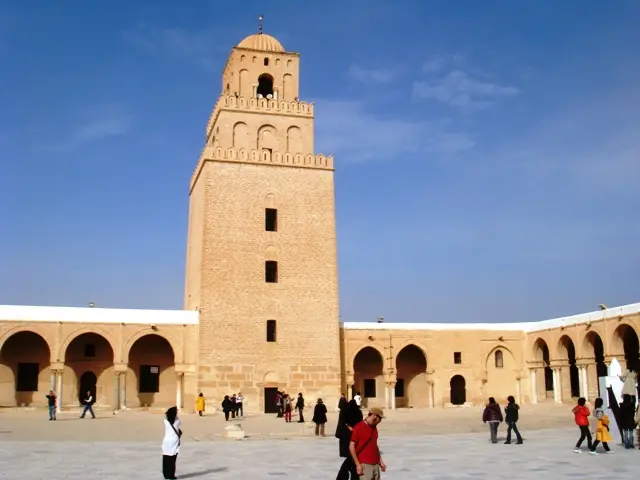
Arab Muslim armies entered Byzantine Ifriqiya from 647. In 670 CE the general Uqba ibn Nafi founded Kairouan as a garrison base inland and began its Great Mosque, one of the oldest and most influential in Islam.
The Berbers, still the great majority of the population, were not united: some fought the conquest, led by Kusaila, who killed Uqba in 683, and by the queen Dihya (“al‑Kahina”), who held out in the Aurès mountains (in present-day Algeria) until about 700; others allied with the Arabs. Carthage fell in 698 and the Arabs built a new port and arsenal at Tunis.
Kairouan became a renowned centre of learning and, for many, the fourth holiest city of Islam, launching the long Islamization and Arabization of the region that reshaped its language, faith and, over centuries, its genome. Many Berbers converted and joined the armies: the conquest of Spain in 711 was led by a Berber, Tariq ibn Ziyad.
Key dates
- 647 CE
- First large Arab expedition into Byzantine Ifriqiya.
- 670 CE
- Uqba ibn Nafi founds Kairouan and begins its Great Mosque.
- 683 CE
- The Berber leader Kusaila defeats and kills Uqba.
- 698 CE
- Arabs take Carthage; Byzantine North Africa falls.
- c. 700 CE
- The Berber queen Dihya (al-Kahina) is defeated in the Aurès.
- 8th c. CE
- Islamization and Arabization spread across the region.
Key figures
- Uqba ibn Nafi · founder, 670 CE
- Dihya · Berber queen, d. c. 700
- Great Mosque · begun 670 CE
From this era
Uqba ibn Nafi
The Arab general Uqba ibn Nafi founded Kairouan in 670 CE as the first Muslim city of the Maghreb.
The Arab conquest
Arab Muslim armies from the Arabian Peninsula carried Islam west from the 7th century, taking Ifriqiya from Byzantium and beginning its lasting Arabization.
The mihrab
Kairouan’s Great Mosque holds one of the oldest mihrabs in Islam, faced with lustre tiles and marble.
A holy city
Kairouan became a great centre of learning and, for many, the fourth holiest city of Islam after Mecca, Medina and Jerusalem.